OmniVTG: A Large-Scale Dataset and Training Paradigm for Open-World Video Temporal Grounding
Abstract
Video Temporal Grounding (VTG), the task of localizing video segments from natural language queries, faces significant challenges in open-world applications. These challenges stem from the limited scale and semantic diversity of existing datasets, which lead to a performance gap between common and rare concepts. To overcome these limitations, we introduce OmniVTG, a new large-scale dataset for open-world VTG, coupled with a Self-Correction Chain-of-Thought (CoT) training paradigm designed to enhance the grounding capabilities of Multimodal Large Language Models (MLLMs). Our OmniVTG is constructed via a novel Semantic Coverage Iterative Expansion pipeline, which first identifies gaps in the vocabulary of existing datasets and collects videos that are highly likely to contain these target concepts. For high-quality annotation, we leverage the insight that modern MLLMs excel at dense captioning more than direct grounding and design a caption-centric data engine to prompt MLLMs to generate dense, timestamped descriptions. Beyond the dataset, we observe that simple supervised finetuning (SFT) is insufficient, as a performance gap between rare and common concepts still persists. We find that MLLMs' video understanding ability significantly surpasses their direct grounding ability. Based on this, we propose a Self-Correction Chain-of-Thought (CoT) training paradigm. We train the MLLM to first predict, then use its understanding capabilities to reflect on and refine its own predictions. This capability is instilled via a three-stage pipeline of SFT, CoT finetuning, and reinforcement learning. Extensive experiments show our approach not only excels at open-world grounding in our OmniVTG dataset but also achieves state-of-the-art zero-shot performance on four existing VTG benchmarks. Code is available at https://github.com/oceanflowlab/OmniVTG.
Video
Method
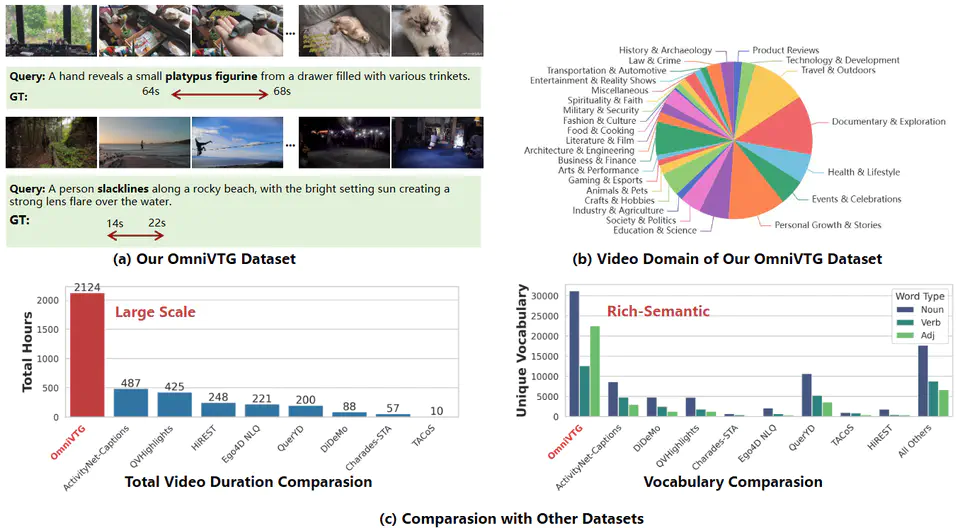
- OmniVTG Dataset: over 2,000 hours of video and rich semantic diversity
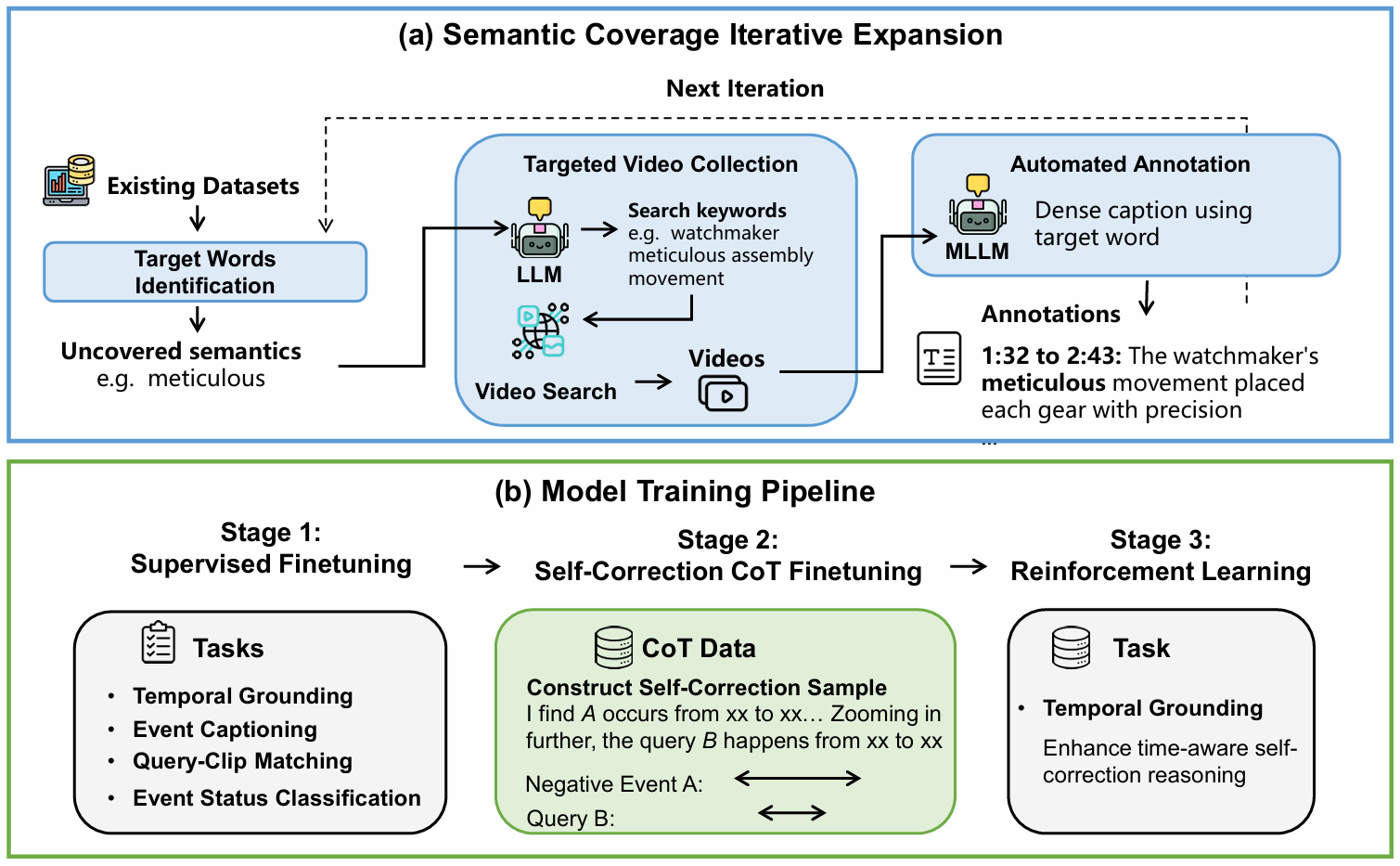
- Data Engine: Semantic Coverage Iterative Expansion pipeline to discover out-of-vocabulary concepts, combined with a caption-centric prompting strategy to automately generate dense, high-quality grounding annotations
- Self-Correction CoT: first make a coarse prediction of the target timestamps, then zoom in and refine it using its video understanding capabilities
Visualizations
OmniVTG Dataset Samples
Qualitative Comparison: OmniVTG Test Set
Qualitative Comparison: Charades-STA
Qualitative Comparison: ActivityNet Captions
Citation
@InProceedings{Zheng_2026_CVPR,
    author    = {Zheng, Minghang and Yin, Zihao and Yang, Yi and Peng, Yuxin and Liu, Yang},
    title     = {OmniVTG: A Large-Scale Dataset and Training Paradigm for Open-World Video Temporal Grounding},
    booktitle = {Proceedings of the IEEE/CVF Conference on Computer Vision and Pattern Recognition (CVPR)},
    month     = {June},
    year      = {2026},
    pages     = {24620-24629}
}